BY SINDISO NHLABATHI:
For years, Ekurhuleni residents have heard promises of better services, cleaner government and economic renewal.
At a community dialogue this week, six councillor hopefuls offered their prescriptions for the metro’s problems, but residents responded with a harder question: what will make this election different?
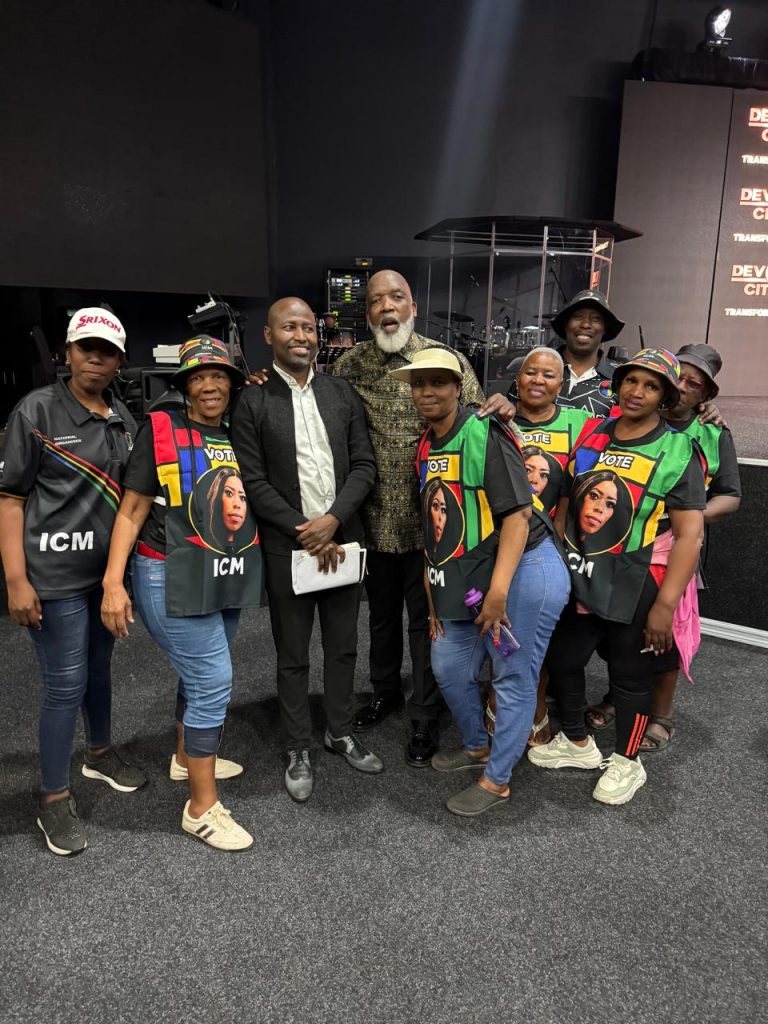
The Devoted Citizens Movement-hosted dialogue at Hope Restoration Ministries came less than a month before the 4 November local government elections and exposed a municipality struggling with infrastructure, unemployment, political instability and public frustration.
Organisers said they invited political parties contesting the City of Ekurhuleni. The ANC did not send a representative, while the uMkhonto weSizwe Party was also absent despite being scheduled to present candidate Thulani Shongwe.
Researcher Makungu Nguni presented figures intended to illustrate the scale of the crisis. Ekurhuleni was described as having about 4.06 million residents and 1.4 million households, alongside eight hospitals and 90 clinics, some of which were described as not fully functional.
More than half of the 163 schools in Ekurhuleni North and 176 in Ekurhuleni South were reported to be overcrowded. The metro also faces 119 informal settlements, 43 abandoned housing projects and an unemployment rate of 37%.
The figures raised a fundamental question: how much of Ekurhuleni’s crisis is a failure of resources, and how much is a failure of political and administrative leadership?
The Democratic Alliance’s Khathutshelo Rasilingwane placed the blame squarely on leadership. She pointed to three mayors in four years, corruption and political instability, arguing that the city needs a return to basic service delivery.
Her promises included functioning roads, reliable water and electricity and stronger consequence management. She also raised concerns about crime and claimed that 300 EMPD vehicles were stuck at workshops.
The EFF’s Nthabiseng Tshivenga offered a different prescription, putting insourcing at the centre of her first 100 days. She also called for the re-industrialisation of Isando, tighter vetting of EMPD officers, improved street lighting, reform of the estimated billing system and stronger revenue collection.
Her proposals included prioritising local SMMEs and ensuring they are paid within 30 days, as well as reviving the city’s tar manufacturing plant to tackle potholes.
When challenged over an allegation linking the EFF to chemical-toilet tenders, Tshivenga rejected the claim and called for anyone with evidence to report it through the appropriate anti-corruption mechanisms.
Dr Joe Mojapelo of the Independent Citizens Movement challenged voters to look beyond mayoral personalities. He argued that residents elect councillors, who then elect the mayor. Ekurhuleni has 112 wards and 224 councillors, comprising ward and proportional-representation representatives.
Mojapelo urged voters to scrutinise party lists and presented his decades of engineering and government experience as an alternative to what he described as conventional political leadership.
Africa Maibuye Movement representative Themba Nzimande, however, argued that experience means little when basic services fail.
“Who needs experience when you can see the grass is not cut? Who needs experience when the lights are off?” he asked.
Nzimande proposed a municipal skills audit, the reopening of factories in Springs and surrounding areas, employment opportunities for people over 35, formalisation of informal settlements and a stronger economic identity for Ekurhuleni.
BOSA candidate Nongelo Chiume placed economic innovation at the centre of his campaign, arguing that underutilised municipal infrastructure could become an economic asset. He also called for ethical leadership and stronger coordination between the municipality and EMPD around school safety.
ActionSA, represented by Siya Makhubo, positioned the party as a potential kingmaker in council. Makhubo pointed to ActionSA’s influence in council negotiations and cited the 2026/27 budget process as evidence of its bargaining power.
Its proposals include an economic development agency for local entrepreneurs, professionalising municipal employees, insourcing, and converting hijacked buildings into affordable housing.
But the most significant intervention did not come from the politicians.
Residents presented a 10-point public mandate demanding clean governance, zero tolerance for corruption, protection of women and children, completion of abandoned projects, reliable water and electricity, sanitation, safer streets, youth employment and faster emergency response.
They also demanded merit-based appointments and accountability that continues after election day. “Before you ask for our vote, listen to the mandate our vote carries,” the declaration stated.
That may ultimately be the real test facing every party campaigning in Ekurhuleni.
The promises are familiar. The crisis is familiar. The question now is whether voters will accept another cycle of political commitments — or demand measurable answers about who failed, what will change, how it will be paid for, and who will be held accountable if the promises are broken.
Senior Pastor Rev SC Mathebula captured the frustration bluntly in his closing remarks: “We have done debates for 30 years and we are in a mess. This is not a game. Don’t gamble with our lives.” – @NewsSA_Online
Follow us on our social media platforms below: