BY THOBILE JIWULANE:
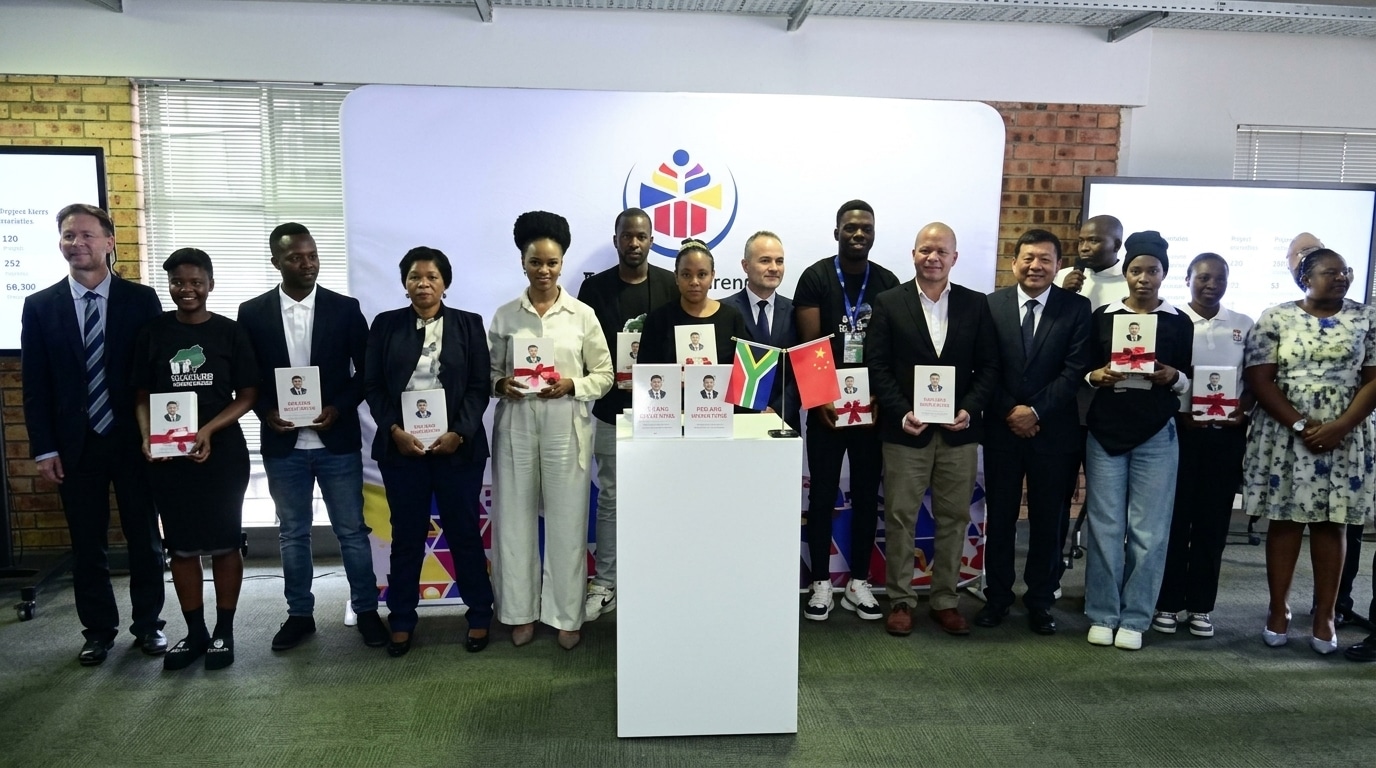
Various guests and academics from both South Africa and China highlighted the significance of the relationship between South Africa and China, making an impassioned call to the youth to serve as a bridge to deepen the youth’s understanding of China’s development philosophy and governance practices.
The guests and scholars deliberated on the concepts and issues raised in the book series ‘Xi Jinping: The Governance of China’, noting that it systematically presents the distinctive features, practical path and remarkable achievements of the Chinese path to modernisation, offering China’s wisdom and approaches that countries of the Global South can draw on in pursuing modernisation together.
They participated in discussions at the International Symposium on “Global South – China Approaches”, which was accompanied by the donation ceremony of the book, Xi Jinping: The Governance of China (English edition), held at Tshwane University of Technology (TUT) in Pretoria on 10 November 2026. The event, hosted by Phoenix Publishing & Media Group (PPMG) and TUT, was co-organised by Veritas and Mercurius Publishing Co., Ltd. and the South African Association of Public Administration and Management (SAAPAM)
The occasion was attended by Song Jinbo of the Cultural Section and Zhao Yong of the Education Section of the Chinese Embassy in South Africa, along with the publishing and academic communities of China and South Africa and a large audience of university students and youth as well as media representatives covering the event. It was aimed at presenting Xi Jinping’s thought on governance to young people in Belt and Road partner countries, and to explore innovative ways of reaching African youth that must be targeted.
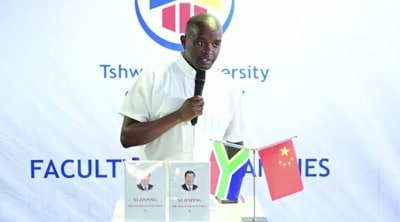
The chair of the day Prof John Molepo of Tshwane University of Technology who implored the young people in South Africa serve as a bridge to deepen the youth’s understanding of China’s development philosophy and governance practices. A message that the young people in the audience received well and noted.
Other speakers further discussed the lessons to be learned from China’s development approach. “Today’s theme is not about copying China. It is about learning from China,” said Prof Mashupye Maserumule, Executive Dean of the Faculty of Humanities, in his welcome address.
Maserumule stressed that China’s development path is an important civilizational lesson that lies beyond the logic of global capital. “China has lifted over 800 million people out of poverty in 40 years… Development is not only about economics and engineering. It is about people. It is about culture, language, ethics, governance, and history. All this I say because I want us to approach this symposium not simply as a lecture but as a dialogue between civilisations.
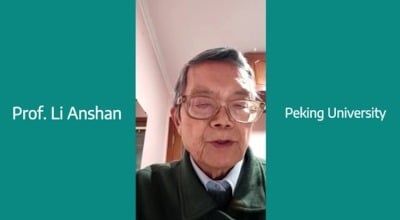
Prof Li Anshan, a renowned scholar of African studies at Peking University, China, who addressed the gathering via a video link from China, described “the Global South as “an open concept, not an exclusive camp.” Li likened South Africa’s Ubuntu philosophy, which holds that “I am because we are,” to the Chinese way of reaching out to other people, adding that Ubuntu is the wisdom of placing the individual within the community, which is consistent with the concept of a community with a shared future for humanity, practised by China.
A “China’s perspective,” he added, “refers to how Chinese people view and study the Global South, not to ‘taking China as the centre ’”; it is the unity of “a sense of humanity, a Chinese standpoint, and concern for the Global South.”
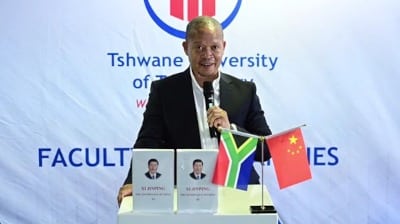
Dr Rasodi Khutso Manyaka, a South African scholar of public administration, said that as the geopolitical landscape undergoes profound change, growing China-Africa relations have become an important underpinning of cooperation among countries of the South.
He noted that “while mainstream academic and political discourse remains heavily focused on economic cooperation, trade volumes, infrastructure investments, and macro-level political engagement, the socio-cultural dimension of these relations demands far greater scrutiny”—which, he said, is both inherent in bringing China’s approaches to the Global South and a gap that must be filled in building a China-Africa community with a shared future.
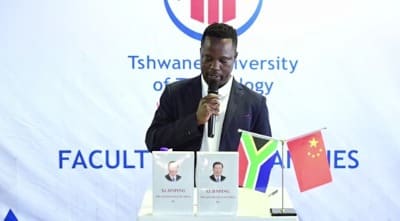
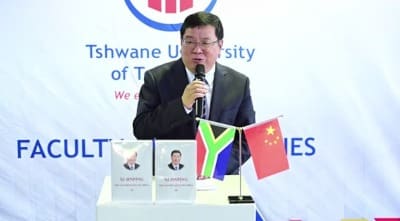
Hu Xiaodong, Deputy General Manager of Phoenix Publishing & Media, Inc., noted that this year marks the 28th anniversary of the establishment of diplomatic relations between China and South Africa. “Jiangsu Province and South Africa enjoy a solid and wide-ranging partnership spanning trade, agriculture, education, culture and many other areas,” he said.
“Phoenix Publishing & Media Group publishes more than 6,000 new titles a year. Phoenix Media has been named to the ‘Global 50’ ranking of the publishing industry for five consecutive years, ranking first among Chinese publishing enterprises.” Behind these figures, he added, “lies a simple and steadfast commitment: to bring good stories and good ideas to more readers.”
A donation ceremony for Xi Jinping: The Governance of China (English edition) followed, with copies presented to South African students to help them study Xi Jinping Thought on Socialism with Chinese Characteristics for a New Era and gain a better understanding of China.
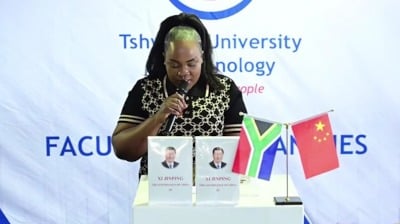
In closing remarks, Prof Kholofelo Rakubu, Assistant Dean of the Faculty of Humanities at Tshwane University of Technology, said she hoped the event would mark the beginning of a deeper academic partnership among institutions, giving young scholars more opportunities to study Xi Jinping’s thought on governance and learn from China’s experience, and helping the Global South contribute more actively to global knowledge production. She added that the books donated at the event will inspire the researchers and leaders of tomorrow.
The event achieved positive outcomes in discussions on the Global South and global governance. The two sides pledged to use their new co-operation opportunity to promote mutual learning among civilisations and reading exchanges among young people, benefiting both. – @NewsSA_Online
Follow us on our social media platforms below: