BY DR FUMENE GEORGE TSIBANI:
History does not repeat itself precisely, but it moves in cycles of approximately eighty years, the lifespan of a generation that has forgotten the catastrophe endured by its grandparents.
The Great Depression of 1929 created the Poor White Problem, especially amongst Afrikaners in South Africa, and globally created the conditions for the Second World War. Mass unemployment, the collapse of trade, and the failure of the League of Nations allowed extremism to flourish. Economic despair became political radicalism, and political radicalism became war.
That is the cycle we must fear today.
The League collapsed because it possessed neither enforcement nor unity. The United Nations Organisation was created in 1945 to prevent a recurrence. Yet today, many citizens ask whether the UNO is failing in the same manner. Resolutions are passed and ignored. The Security Council is paralysed by vetoes. Peacekeeping is underfunded. International law is invoked selectively, and often only when it suits the powerful.
The recession of 2008, and the slower growth, debt and inequality that followed, corroded trust in global institutions. The European Union, once hailed as a model of peace through integration, now faces internal division, energy shocks, migration pressures and profound questions about its own cohesion. The collapse is not yet formal, but it is a collapse of confidence, which in the history of globalisation is often the precursor to a collapse of order.
When institutions collapse, power fills the vacuum. We saw it in Iraq in 2003, when the United States and its allies invaded on the basis of weapons of mass destruction that were never found. We saw it in Libya in 2011, when a NATO-led intervention to protect civilians ended in regime change and state collapse, leaving a fractured country and a corridor for migration, terrorism and modern-day slavery. We saw it in Syria, in Yemen, and in the wider Middle East, where great-power rivalry was fought through proxies and civilians paid the price.
More recently, we have seen it in Ukraine, where Russia’s full-scale invasion in 2022 became a war between Russia and NATO by proxy, and in the Middle East, where the United States-Iran confrontation has escalated into direct war, with grave consequences for energy, shipping and civilian life.
This pattern has been worsened by three shocks that no military alliance could prevent: Ebola, COVID-19 and climate change.
The Ebola outbreaks in West Africa in 2014-2016, and later in the Democratic Republic of Congo, exposed the fragility of health systems and the slowness of global response. More than 11,000 people died in West Africa alone. Economies contracted, schools closed, markets collapsed, and trust in government fell. Ebola taught the world that a health crisis is also a security crisis, and that insecurity breeds instability.
COVID-19 taught the same lesson on a global scale. From 2020, the pandemic killed millions, disrupted supply chains, closed borders, and pushed more than 100 million people back into extreme poverty, according to the World Bank. In South Africa, it exposed inequality in housing, water and sanitation. In Europe, it exposed dependence on external supply chains. Globally, it exposed the failure of vaccine equity, as rich nations hoarded doses while poor nations waited. The pandemic did not cause war, but it weakened the institutions that prevent war.
Climate change is now doing the same, more slowly and more relentlessly. Devastating floods have become a defining feature of our age. In South Africa, the KwaZulu-Natal floods of 2022 killed more than 400 people and destroyed homes, roads and water infrastructure. In Libya, the Derna floods of 2023 killed thousands after dams collapsed. In Pakistan in 2022, floods submerged one-third of the country and displaced 33 million people. In Europe, floods in Germany and Belgium in 2021, and in Spain in 2024, shattered the illusion that climate disaster is a problem of the poor alone.
Floods are not only water. Like scorched-earth military tactics, they are part of creating global insecurities. In classical scorched-earth warfare, an army destroys crops, poisons wells, burns villages and breaks dams to deny the enemy sustenance and to force displacement. Floods, whether natural or made worse by dam failure, deforestation, poor planning and deliberate destruction of water infrastructure, achieve a similar effect. They destroy crops, contaminate drinking water, spread cholera and disease, displace families, and create competition for land and resources.
This is precisely the warning issued at COP23 in Bonn in 2017, under the Fijian Presidency. COP23 insisted that climate change is not an environmental issue alone, but a security issue. It linked rising seas, extreme rainfall and flood risk to displacement, food insecurity, loss of livelihoods, and conflict. It called for loss and damage, adaptation, and climate justice, because those who contributed least to emissions suffer most from its consequences. The floods of today are the security crises of tomorrow.
In the Sahel, in the Horn of Africa, and in Southern Africa, climate-driven food insecurity is now a driver of conflict, migration and state fragility. A country that cannot protect its citizens from floods cannot protect them from war.
This is the context of the eighty-year cycle: economic crisis, pandemic, climate disaster, institutional failure, military invasion, and then wider conflagration.
Two new threats make this cycle more dangerous than the last. The first is nuclear weapons. Today, nine states possess them. Russia has the largest stockpile, followed by the United States, with China third and expanding. The expiry of New START in February 2026 removed the last major bilateral arms control treaty. The second is artificial intelligence, which compresses decision time, automates disinformation, and can be integrated into drone warfare and cyber-attacks. A miscalculation that once took days could now unfold in minutes.
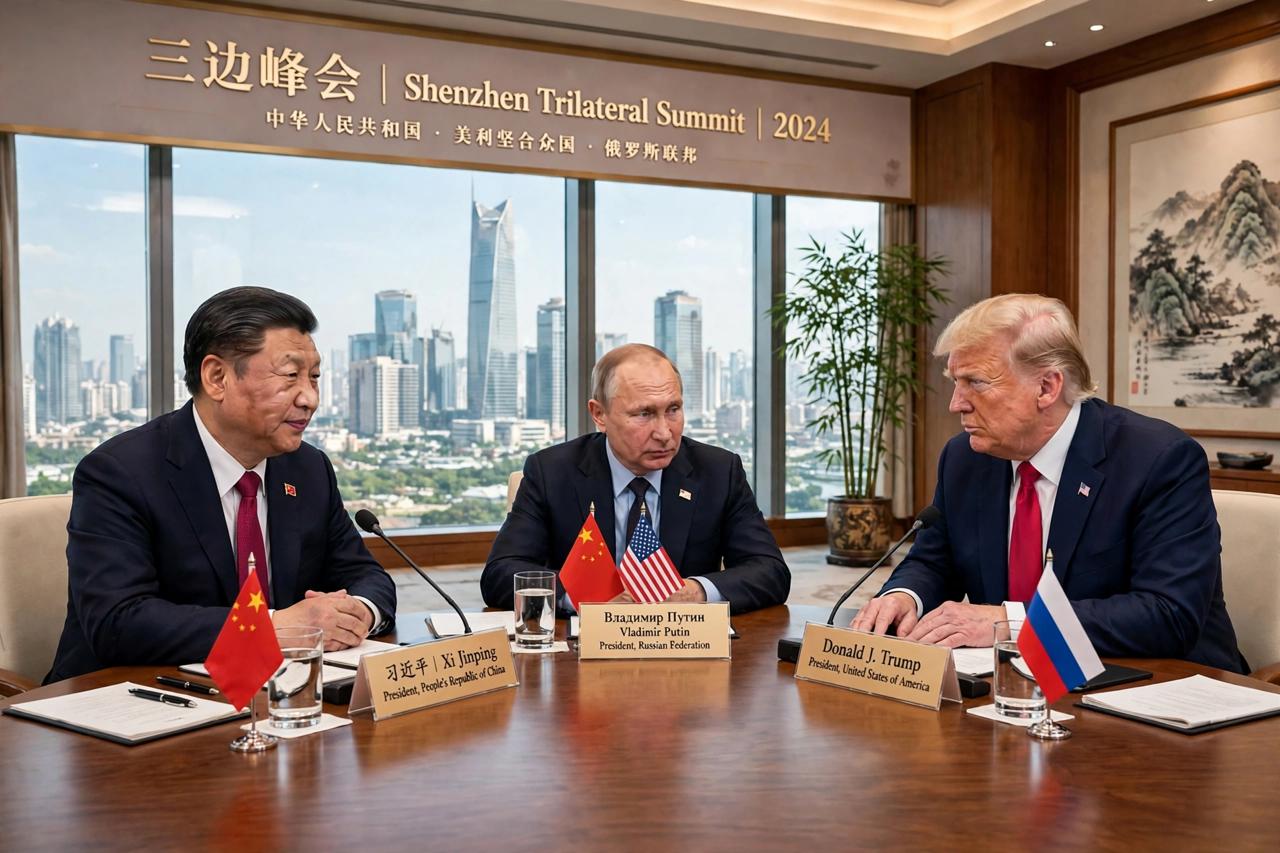
It is in this context that the meeting in Shenzhen on 19 November 2026 must be understood. For the first time, the leaders of the world’s three largest military powers, President Xi Jinping, President Donald Trump and President Vladimir Putin, met together. They met for about ninety minutes. They issued a peace declaration pledging to reduce nuclear risks, to uphold strategic stability, and to reform the United Nations.
Critics will say, rightly, that ninety minutes cannot solve Ukraine, Iran, Taiwan, or AI governance. Yalta lasted eight days, from 4 to 11 February 1945, with armies of diplomats. Shenzhen lasted ninety minutes. Yalta was a meeting of allies. Shenzhen was a meeting of rivals.
But that is precisely why Shenzhen matters. In 1945, Churchill, Roosevelt and Stalin met to divide a world they had won. In 2026, the three leaders met to prevent a world they might lose. The hope is not that they agreed on everything. The hope is that they agreed to keep talking.
If history repeats itself in a cycle of eighty years, then 1945 plus eighty is 2025. The question is whether this generation will repeat the mistakes of the 1930s, or learn the lesson of 1945.
For Africa, the stakes could not be higher. Africa was not at Yalta. Africa was not at Shenzhen. Yet Africa will pay the price of a Third World War, through food prices, energy prices, floods, pandemics and migration. The African Union must insist that no new Yalta be negotiated over our heads.
The three superpowers cannot save the world alone. But they can prevent its destruction, if they choose dialogue over dominance, arms control over arms racing, and law over force. The eighty-year cycle is not destiny. It is a warning. Let Shenzhen be remembered not as a new carve-up, but as the moment when three rivals chose, however imperfectly, to step back from the abyss.
Dr Fumene George Tsibani (Water Governance and Heritage Expert) at the University of Johannesburg. Writing in his personal capacity. – @NewsSA_Online
Follow us on our social media platforms below: