BY DR FUMENE GEORGE TSIBANI:
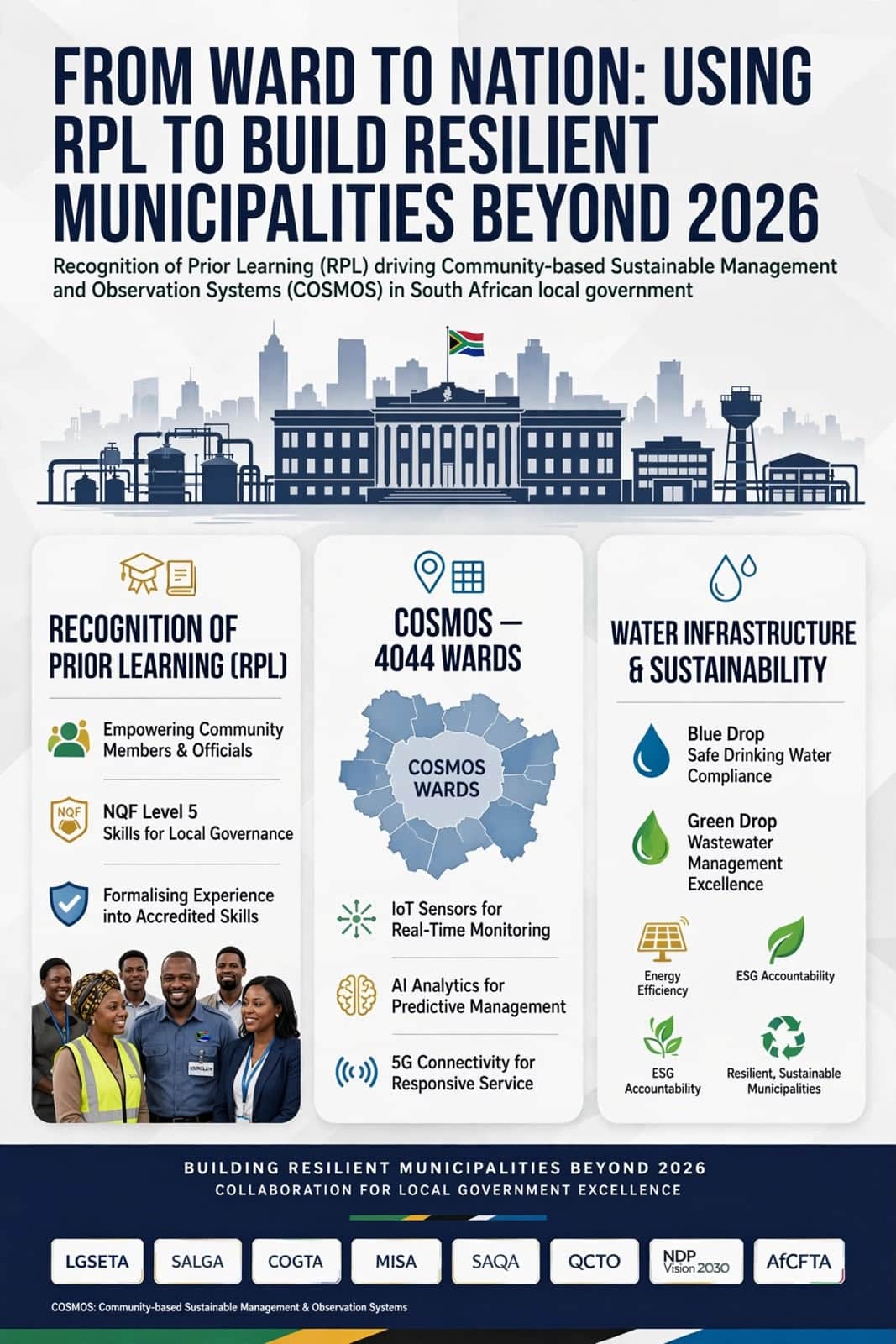
Local government after 4 November 2026 needs a decisive shift from compliance to competence.
South Africa has 4044 wards across 257 municipalities, including eight metropolitan municipalities and 144 Water Services Authorities (WSAs). All face the same compounding pressures: climate shocks, failing infrastructure, rapid technological change and declining public trust. Recent floods and loss of life have shown that planning based on historic data is no longer sufficient.
The answer lies in unlocking what the country already has: the practical knowledge of councillors, officials and community leaders accumulated over thirty years of service delivery. That is where Recognition of Prior Learning (RPL) becomes critical. RPL must now be deliberately deployed to drive Community-based Sustainable Management and Observation Systems (COSMOS).
RPL is not new. It emerged after the Second World War to recognise soldiers whose skills in engineering, logistics, health and leadership were learned on the battlefield, not in classrooms. Universities developed methods to assess what a person could do, not only where they learned it. That principle remains transformative. Competence counts more than certificates. That logic is now directly relevant to local government.
In South Africa, RPL carries a deeper meaning. Apartheid education systematically excluded black experiential knowledge and community governance from formal qualifications. The democratic government corrected this through the South African Qualifications Authority (SAQA), the National Qualifications Framework (NQF) and the Quality Council for Trades and Occupations (QCTO). In that context, RPL became a tool for inclusion, redress and capability building. Today, that same tool must be used to professionalise the ward.
That capability remains uneven in municipalities. Local government is constitutionally mandated to be developmental, yet many councils operate as closed systems, insulated from citizen knowledge. Service delivery protests, non-revenue water losses and poor audit outcomes reflect persistent gaps in capability, capacity, accountability and responsiveness. COSMOS addresses that gap directly.
COSMOS was shaped by a longitudinal study conducted between 2013 and 2023, funded by the German Federal Ministry of Education and Research (BMBF). The study was tested in South Africa in Mpumalanga, Sekhukhune and Limpopo, with Lepelle Northern Water (LNW) and the Kaap Water User Association as institutional partners, and in Windhoek in Namibia. It examined water governance, infrastructure performance and community-based monitoring under climate variability and institutional change.
The findings point to a ward-based governance and learning system that links community observation with municipal planning and infrastructure management. It is designed to help WSAs achieve Blue Drop, Green Drop and No Drop certification within Integrated Water Resources Management (IWRM). It also provides practical models for the refurbishment and rehabilitation of Wastewater Treatment Works (WWTWs), aligned to National Treasury requirements for capability, accountability and responsiveness.
At its core, COSMOS integrates four efficiencies that determine municipal viability. The first is Energy Efficiency, linked to renewable energy and the just transition. The second is Environmental and Spatial Efficiency, linked to integration of rural and urban settlements. The third is Engineering and Infrastructure Efficiency, linked to resilient water, sanitation, roads and stormwater systems. The fourth is Economic Efficiency, linked to Business Expansion, Attraction and Retention (BEAR). Together, they support Environmental, Social and Governance (ESG) principles and green engineering. These efficiencies are interdependent. Failure in one undermines the others.
This must be a joint national effort led by the Local Government Sector Education and Training Authority (LGSETA), the Public Service Sector Education and Training Authority (PSETA), the Education, Training and Development Practices Sector Education and Training Authority (ETDP SETA), the South African Local Government Association (SALGA), the Department of Cooperative Governance and Traditional Affairs (COGTA) and the Municipal Infrastructure Support Agent (MISA). These institutions have the mandate, the footprint and the funding mechanisms to implement RPL at scale. No single institution can achieve this alone.
The alignment to global goals is deliberate. Quality education provides the assurance anchor through SAQA and the QCTO. Innovation anchors industry and infrastructure. Sustainable cities and communities anchor smart communities. Water, energy and climate goals anchor mitigation, adaptability and resilience. This allows municipalities to pursue a single developmental outcome beyond the elections of 4 November 2026, aligned to a 2050 vision for local government and African Union Agenda 2063.
In this model, RPL functions as an accelerator. Councillors and officials who will exit the system after the elections hold institutional memory in service delivery, disaster management and community mediation. If that knowledge is not formalised, it is lost. Formalising it through NQF Level 5 RPL pathways enables retention and conversion into mentorship, local oversight and community-based monitoring. In this way, institutional memory becomes an asset rather than a casualty of political transition.
To be effective, implementation must be practical. A cohort approach per province, delivered through credible public and private training providers, will allow for proper assessment, moderation and workplace application. Learning will be demonstrated through Portfolios of Evidence (PoEs), workplace observation and community monitoring records, not only through examinations. This ensures that assessment is authentic and rooted in the realities of the ward in a municipality.
The technological imperative makes this urgent. Municipalities must adapt to the Internet of Things (IoT), Artificial Intelligence (AI), Big Data, fibre networks, robotics and the evolution from 5G to 6G and 7G connectivity. Billing systems, leak detection, flood early warning and infrastructure maintenance will all depend on these tools. RPL provides a bridge between experiential governance knowledge and these emerging literacies. Without that bridge, digital transformation will deepen exclusion rather than reduce it.
Three practical steps should follow. First, the Sector Education and Training Authorities (SETAs), SALGA, COGTA and MISA should establish a joint RPL task team to co-design a national COSMOS curriculum and assessment framework, with clear roles for ward governance, public administration and pedagogy, informed by evidence from Sekhukhune, Mpumalanga, Limpopo and Windhoek. Second, the framework should be piloted as a legacy programme of the LGSETA, with QCTO accreditation and SAQA registration, linking learning outcomes to Blue Drop, Green Drop, No Drop, BEAR and ESG indicators. Third, delivery should be through a network of credible providers using blended learning, workplace evidence and community observation portfolios, ensuring scalability across all 4044 wards.
The intended outcomes are measurable. RPL will help reconstruct institutional memory, restore public confidence, review service delivery performance, revise Standard Operating Procedures (SOPs), reinvent appropriate technologies, redevelop resilient infrastructure, rethink governance and reimagine developmental local government. These outcomes build on each other sequentially and create coherence between learning and service delivery.
These are not abstract ideals. They are curricular outcomes that can be assessed, moderated and certified, and that citizens will experience through clean water, working streetlights and functioning infrastructure.
The local government we need in South Africa beyond 2026 must be capable of mitigating climate risk, adapting to global change and demonstrating resilience where it matters most, in the ward. Deploying RPL to drive COSMOS and infrastructure investment models is a practical pathway to achieve a Local Government Developmental Agenda (LGDA) aligned to the National Development Plan (NDP) Vision 2030, and African Continental Free Trade Agreement ( AfCFTA).
Dr Fumene George Tsibani is a Water Governance and Heritage Expert at the University of Johannesburg, writing in his personal capacity. – @NewsSA_Online
Follow us on our social media platforms below: